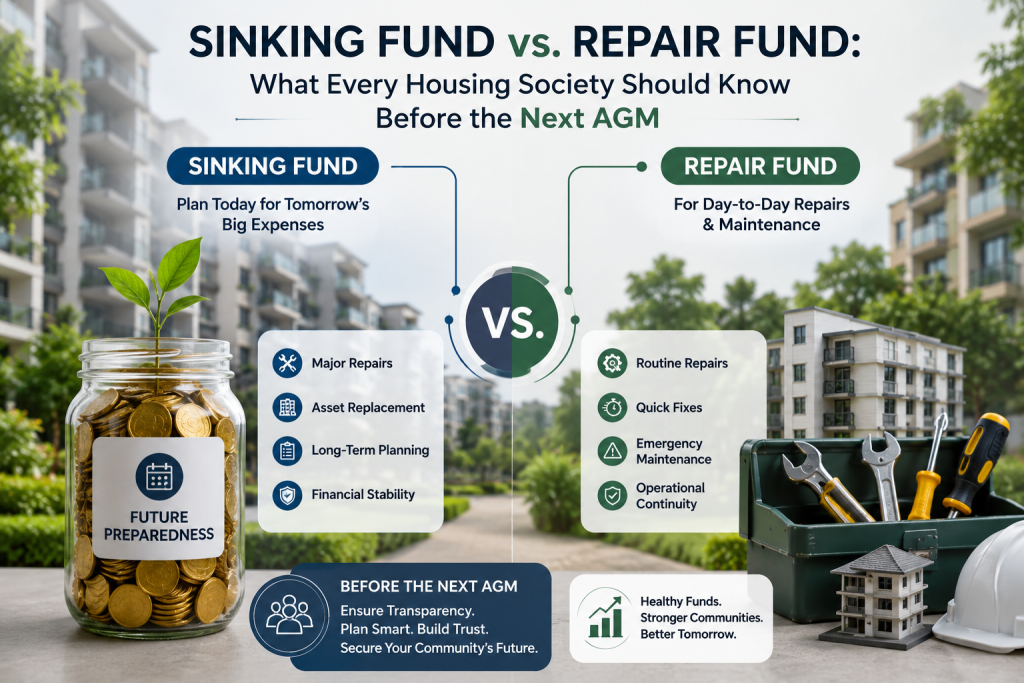
Ask five committee members what the difference is between a sinking fund and a repair fund, and you’ll often get five different answers. Yet this distinction sits at the center of nearly every AGM disagreement about money — and getting it wrong can leave a society financially exposed when a major expense actually shows up.
Two Funds, Two Very Different Purposes
Both funds collect money from residents over time, which is why they get confused. But they exist to solve different problems.
The Repair Fund (Sometimes Called the Maintenance Fund)
This covers routine, predictable upkeep — repainting common areas, servicing lifts, fixing a leaking pipe, replacing a broken gate motor. It’s meant to be spent regularly, within the same financial year it’s collected in most cases. Think of it as the society’s operating budget for wear and tear.
The Sinking Fund
This is a long-term reserve, built specifically for large, infrequent expenses — structural repairs, waterproofing the terrace, replacing the lift entirely, or major fire safety upgrades. In many states, contributing to a sinking fund is a legal requirement under housing society bye-laws, not optional. Critically, this fund is not meant to be touched for day-to-day repairs.
Why Societies Get Into Trouble Here
The most common financial mistake in housing societies isn’t underfunding — it’s misallocation. A leaking terrace gets patched using sinking fund money meant for a full structural repair five years down the line. A society draws down its sinking fund for an “urgent” lift repair because the repair fund ran dry that month. Each individual decision looks reasonable in isolation. Over several years, the sinking fund ends up far smaller than the bye-laws — and reality — require.
This usually surfaces at the worst possible time: when the building actually needs that structural repair, and the fund meant to cover it has quietly been drained for years of smaller emergencies.
How Much Should Actually Be in the Sinking Fund?
Most state housing society regulations specify a minimum contribution — commonly a percentage of the service or maintenance charges, collected monthly or quarterly. But the legal minimum is often a floor, not a target. A more realistic approach factors in:
- The building’s age and expected major repair cycles (waterproofing every 5-7 years, repainting every 3-5, lift overhaul every 10-15)
- Rough cost estimates for each of those future expenses, adjusted for inflation
- A buffer for genuinely unplanned structural issues
Committees rarely do this calculation once, let alone revisit it periodically — which is exactly why so many sinking funds fall short when they’re actually needed.
What This Means at AGM Time
Every AGM should include a clear, separate statement of the sinking fund balance versus the repair fund balance — not a single combined “reserves” number. When residents can see the sinking fund trending flat or declining while the building ages, it becomes a lot easier to justify a contribution increase, rather than discovering the shortfall the year a real structural issue appears.
Getting the Separation Right, Practically
The cleanest way to prevent misallocation is structural, not just procedural — having accounting systems that track these as genuinely separate ledgers, not just separate line items in a spreadsheet that’s easy to blur together under pressure. Platforms like HousingERP maintain sinking fund and repair fund as distinct, auditable ledgers, making it far harder for a mid-year decision to quietly borrow from the wrong pool — and making the AGM presentation of both funds accurate without extra manual work.
A Simple Checklist Before Your Next AGM
- Confirm the sinking fund and repair fund are tracked as separate ledgers, not combined
- Check whether any sinking fund withdrawals happened this year, and whether they were genuinely structural in nature
- Compare your current sinking fund contribution rate against your state’s minimum requirement
- Get a rough estimate for your building’s next major expected expense (waterproofing, lift, structural audit) and compare it to the current sinking fund balance
- Present both fund balances separately and clearly to residents at the AGM
Final Thought
Sinking fund shortfalls are rarely caused by one bad decision — they’re the slow result of many small, reasonable-seeming ones. The fix isn’t complicated: keep the funds genuinely separate, revisit the numbers annually, and make sure residents can see the real picture before it becomes an emergency special levy.
Talk to our team about setting up proper fund tracking for your society, or see how HousingERP handles this automatically.