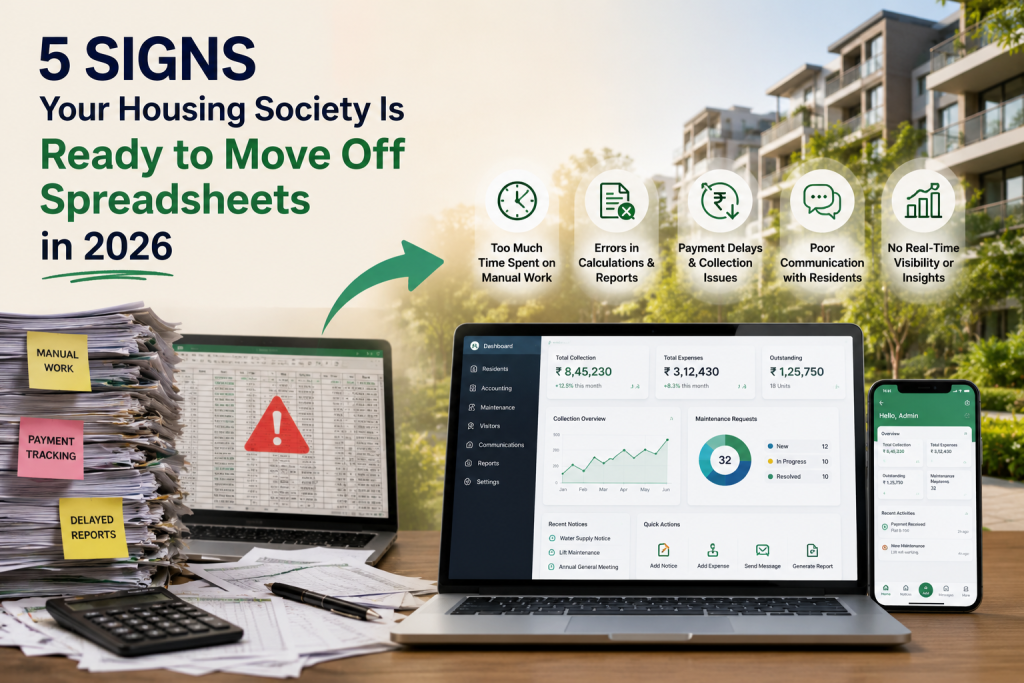
Every housing society starts somewhere — usually a shared Excel sheet, a WhatsApp group for announcements, and a diary for maintenance requests. It works fine for a while. But there’s a point where the manual system stops being “good enough” and starts actively costing the society time, money, and trust. Here’s how to tell you’ve reached that point.
1. Your Treasurer Dreads Month-End
If closing the books each month means hours of manually cross-checking bank statements against a spreadsheet ledger, that’s the clearest sign. Manual reconciliation is not just slow — it’s where most accounting errors creep in, and those errors compound every financial year until an audit finally catches them.
2. Maintenance Dues Are Tracked in Someone’s Head
When “who’s paid and who hasn’t” lives in a committee member’s memory or a personal notebook rather than a system, the society is one resignation away from losing that institutional knowledge entirely. It also makes it nearly impossible to send fair, consistent reminders — some residents get chased, others slip through.
What this actually costs
- Delayed collections that quietly strain the society’s cash flow
- Awkward, inconsistent follow-ups that damage resident relationships
- No historical record when a resident disputes a due amount
3. Complaints Get Lost in Group Chats
A WhatsApp group is not a ticketing system. Maintenance requests posted there get buried within hours, have no owner, and no way to confirm resolution. Residents end up posting the same complaint three times because no one can tell if it was actually addressed.
4. Committee Handovers Are Painful
Managing committees change every year or two. If all financial and operational knowledge is locked in one outgoing member’s personal spreadsheets, every handover starts from near-zero. A proper system means the next committee inherits clean, structured records — not a folder of inconsistent Excel files.
5. You Can’t Answer Simple Questions Quickly
“How much did we spend on security this year?” or “How many units still owe Q2 dues?” should take seconds to answer, not an afternoon of digging through files. If every committee meeting involves someone saying “let me check and get back to you,” that’s a system problem, not a people problem.
What Moving On Actually Looks Like
Switching away from spreadsheets doesn’t mean a disruptive overhaul. A sensible transition typically follows this order:
- Digitize the ledger first — move accounting into a proper cloud-based system
- Automate due tracking and payment reminders
- Introduce a structured complaint/ticket system for maintenance requests
- Enable simple, self-serve reporting for committee members
This is exactly the gap platforms like HousingERP are built to close — replacing scattered spreadsheets and group chats with one connected system for accounting, dues, and maintenance, without requiring committee members to become accountants or IT admins.
Final Thought
Spreadsheets aren’t inherently bad — they’re just the wrong tool once a society grows past a certain size or complexity. The signs above are less about technology and more about protecting committee members’ time and the society’s financial accuracy.
Talk to our team about what a transition would look like for your society, or explore HousingERP directly.