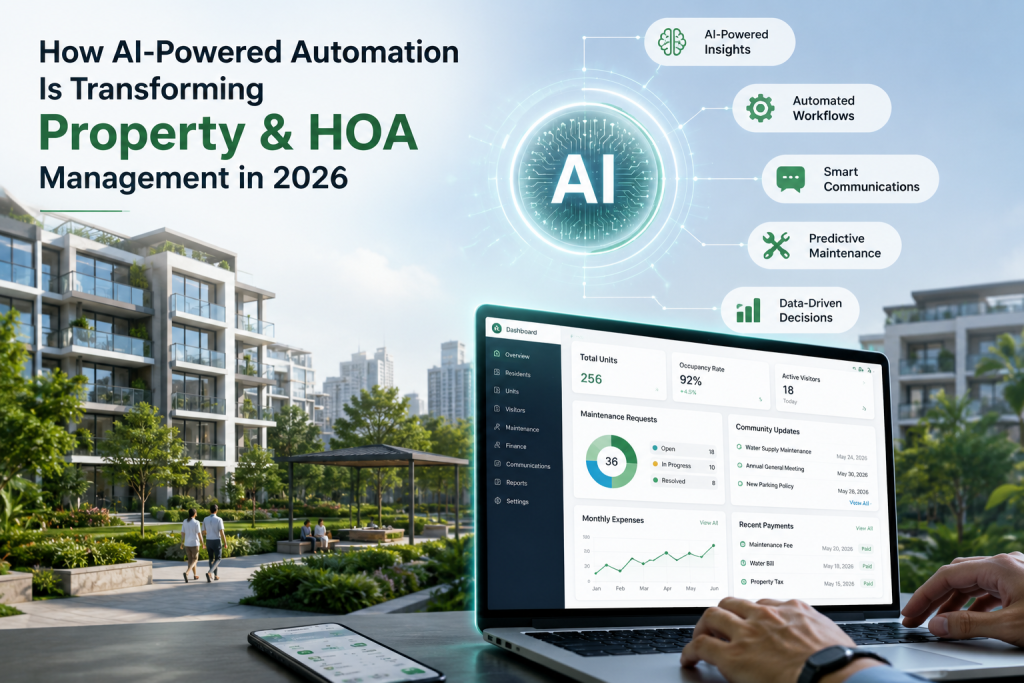
Running a housing society or managing a portfolio of properties used to mean stacks of paper ledgers, manual rent reminders, and hours spent reconciling accounts by hand. That’s changing fast. Artificial intelligence is quietly becoming the backbone of modern property management — not as a buzzword, but as a practical tool solving real operational headaches.
The Problem With Traditional Property Management
Most housing societies and property management companies (PMCs) still juggle a patchwork of spreadsheets, WhatsApp groups, and physical registers. This creates three recurring pain points:
- Delayed collections — manual tracking means missed maintenance payments go unnoticed for weeks
- Reconciliation errors — human-entered ledgers are prone to mistakes that compound over financial years
- Slow response times — resident complaints and maintenance requests get lost in group chats instead of being tracked to resolution
Where AI Actually Helps (Not Just Hype)
The most effective AI applications in property management aren’t flashy — they’re the unglamorous automation of repetitive decisions:
1. Predictive Maintenance Alerts
Instead of waiting for a resident complaint, AI-driven systems can flag patterns — like a lift that’s had three minor faults in two months — before a full breakdown happens. This shifts maintenance from reactive to proactive, cutting both cost and resident frustration.
2. Smart Payment Reminders
Rather than a blanket reminder to every resident on the 1st of the month, automated systems can time reminders based on each resident’s historical payment behavior — nudging early for chronically late payers, and staying quiet for those who always pay on time.
3. Automated Financial Reconciliation
This is where the real time savings show up. Modern ERP platforms can automatically match bank statement entries against ledger records, flag discrepancies instantly, and maintain an accurate, dynamically-computed running balance — instead of a manually updated number that silently drifts wrong over time.
4. Natural-Language Reporting
Committee members increasingly expect to just ask a question — “How much did we spend on security last quarter?” — instead of digging through a report generator. AI-assisted querying is starting to make this normal, even for non-technical managing committee members.
What This Means for Housing Societies in India
For Indian housing societies specifically, the shift matters because committee members are volunteers, not full-time accountants. Every hour saved on manual reconciliation is an hour a resident volunteer gets back. Platforms like HousingERP are built around this exact principle — combining a full accounting and maintenance management system with automation that reduces the burden on committee members, not just digitizes the paperwork.
Getting Started Without Overhauling Everything
Societies don’t need to adopt AI wholesale on day one. A practical rollout looks like:
- Start with digitized, cloud-based ledger management (removes the manual-error problem first)
- Add automated payment reminders and dues tracking
- Layer in predictive maintenance once historical data has built up
- Introduce reporting automation for committee meetings
Final Thought
AI in property management isn’t about replacing the people who run housing societies — it’s about removing the repetitive, error-prone work that eats up their time, so committees can focus on actual community decisions instead of chasing spreadsheets.
Curious how this looks in practice? Get in touch with our team or explore what HousingERP can do for your society.